Cranial Adjusting in Johnston
If you’ve been dealing with persistent headaches, TMJ discomfort, or sinus issues that just won’t quit, there may be more to the story than you realize. The bones in your skull are meant to move slightly, and when they lose that natural motion, it can affect the way your nervous system functions. Cranial adjusting is a gentle technique that can help restore proper movement and support overall function for patients of all ages—including newborns and infants, where subtle cranial restrictions may contribute to issues such as difficulty latching, feeding challenges, excessive fussiness, or tension following birth.
Understanding How Your Skull Moves
Many people are surprised to learn that the bones of the skull are not fused into one solid structure. Small joints and sutures between the cranial bones allow for subtle but important movement. These bones work together with a protective layer called the dura, which surrounds your brain and spinal cord. Cerebrospinal fluid flows through this system, delivering nutrients and clearing away waste.
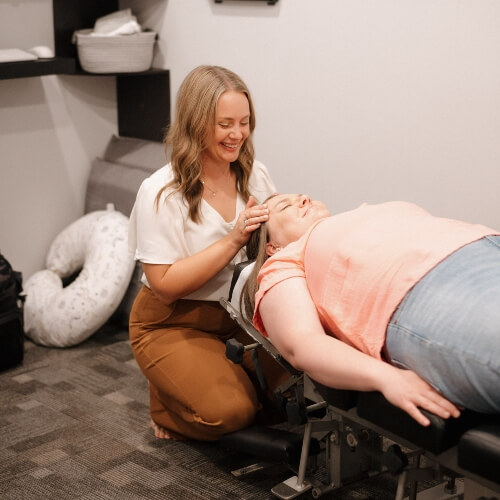
When restrictions develop in the cranial bones or surrounding dura, that fluid may not circulate as efficiently. Cranial adjusting uses very light, precise pressure to restore normal motion. The technique is incredibly gentle, often highly calming, and is appropriate even for newborns.
Who Can Benefit From Cranial Adjusting?
Cranial adjusting is commonly used for infants and young children. During birth, a baby’s cranial bones naturally overlap to allow passage through the birth canal and may need gentle guidance to settle back into alignment afterward, particularly following a challenging delivery or certain positions in the womb.
We often evaluate newborns experiencing colic, reflux, nursing or latch difficulties, ear infections, torticollis, sleep concerns, or flat spots on the head. Flat spots can develop when a baby consistently prefers turning their head to one side, creating uneven pressure on the still-developing skull. We also assess the palate, since an asymmetrical or narrow palate can make latching and feeding more difficult.
Adults may also benefit from cranial adjusting for headaches, migraines, TMJ dysfunction, and recurring ear or sinus concerns.
Why Cranial and Spinal Care Work Together
The dura surrounding your brain continues through the spinal canal all the way to the sacrum, creating an important connection between your cranium and spine. Restrictions affecting the cranial bones can influence spinal movement, while spinal joint restrictions can create tension that extends upward into the head.
Addressing both cranial and spinal alignment during the same visit allows us to take a more complete approach to your care.
Schedule Your Cranial Adjustment
If you or your little one are dealing with symptoms that haven’t responded to other approaches, consider cranial adjusting at Herrmann Family Chiropractic. Contact us today to schedule an appointment and learn whether this gentle technique may be a good option for you.
